

5 Surprising Truths About the AI Revolution You Haven’t Heard Yet
Direct Answer: The AI revolution is less about technical coding and more about strategic positioning, protecting the "experience gap" for entry-level staff, and shifting our focus from finding answers to asking the right questions to ensure human-centred, ethical outcomes.
It is impossible to ignore the constant stream of news about Artificial Intelligence. Every day brings headlines about more powerful models, new creative tools, and unsettling predictions about the future of work. It can feel overwhelming. It is easy to get lost in the noise of the technological arms race.
But beyond the headlines lies a more profound story. To understand the AI revolution, we must follow a path from immediate business decisions to the deep, human-centred shifts that will redefine our careers, our skills, and even our purpose.
I recently sat down with David Espindola, a 30-year tech industry veteran and author of Soulful: You in the Future of Artificial Intelligence, on the AI Grapple Podcast. We uncovered five truths that map this journey, moving from practical strategy to a philosophical vision for our future.
1. You Don’t Need to Build AI - You Just Need to Decide Your Role
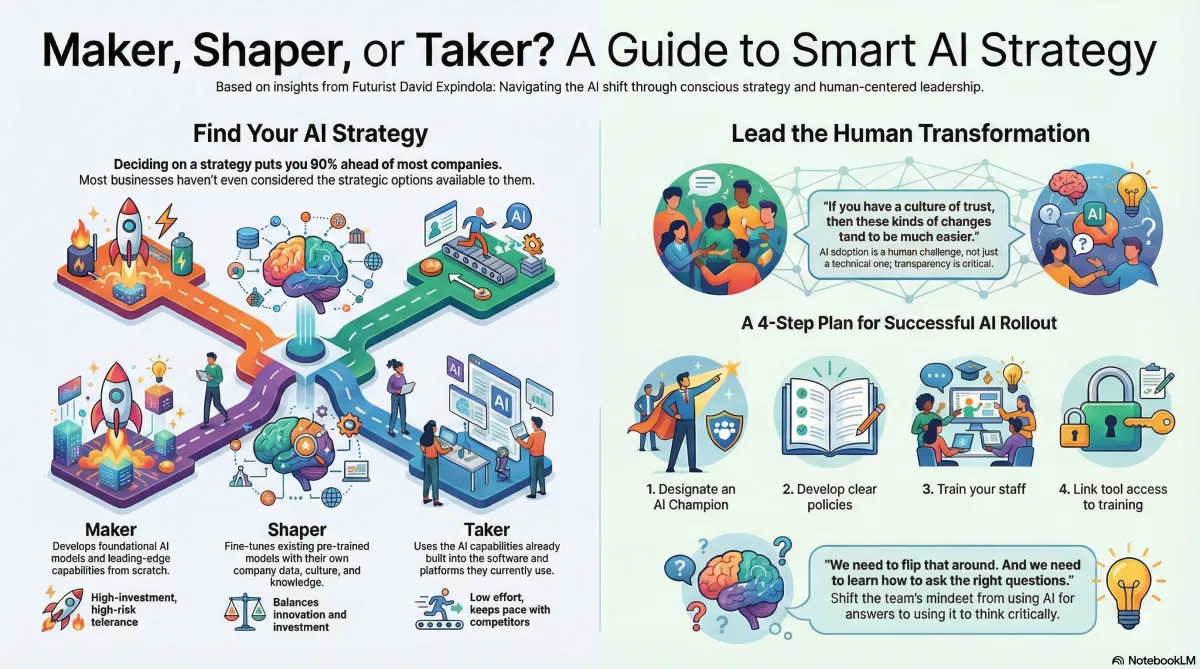
Many small business owners are struggling with AI. They know it is important, but complexity and a lack of clear starting points leave them paralysed. The solution isn't to become a developer overnight. It is to make a single, clear strategic decision. A simple framework from McKinsey clarifies your options:
Makers: These organisations have deep pockets and high risk tolerance. They build new AI models from the ground up.
Takers: This is the most common approach. Takers use AI built into everyday software like Microsoft Office or Salesforce. This keeps you level with competitors but offers no unique edge.
Shapers: This is where the magic happens. Shapers take pre-trained models and fine-tune them with their own unique company data, culture, and expertise.
By deciding which role you play, you are already ahead of most companies.
2. AI Isn’t Just Taking Jobs, It’s Taking Our Training Ground
The most common fear is that AI will eliminate jobs. While that is a valid concern, there is a more subtle problem: the erosion of entry-level roles.
David notes a prediction that about half of all entry-level jobs could be eliminated. These positions are the primary training ground for foundational experience. If AI automates these, it creates an "experience gap" that threatens future leadership.
Navigating this requires transparent leadership. We must be upfront about which tasks are changing while creating new training pathways. The goal is to help people gain the education they need to transition into the new roles AI helps create.
3. We Need to Stop Learning Answers and Start Asking Questions
Our education system has been built on teaching people how to find the correct answers. This model is rapidly becoming obsolete. In a world where AI provides answers in seconds, the value has shifted to knowing what to ask.
The most valuable human skill now is the ability to ask the right questions. This requires a deep understanding of "first principles." Without this grounding, you cannot critically evaluate an AI's response or check its sources. We must prioritise critical thinking to challenge our AI collaborators, not just delegate to them.
4. AI Can Write Code, But It Can’t Handle a Three-Way Conversation
In a fascinating experiment, David made his custom-trained AI co-host a podcast. He discovered that current AI is not yet ready for group social dynamics. It would get confused about who was talking or fail to grasp subtle turn-taking.
However, when asked about marketing privacy, the AI cut through the jargon with a startlingly insightful question. This reveals a nuanced truth: AI's social intelligence is brittle. It is capable of both basic gaffes and profound, unexpected insight. Mastering human interaction remains a distant frontier for the machines.
5. The Future Is About Working for Joy
While we focus on immediate disruptions, the long-term view is optimistic. The ultimate promise of AI is the creation of "abundance." By having AI handle the manual, boring tasks that consume our lives, we can change our relationship with work.
The potential outcome is a world where humanity is freed to pursue work that is creative and fulfilling. David describes this as an opportunity to elevate our purpose. Work won't be for sustenance; it will be for enjoyment.
FAQ: Navigating the AI Shift
How do I start using AI responsibly in my business? Start with an AI audit. Map your tasks and processes to see where AI can add the most value without compromising your ethical standards.
What skills should I focus on for the future? Focus on critical thinking, social intelligence, and "prompt engineering" - the art of asking the right questions to get the best results from AI.
Will AI replace my human team? AI enhances human capability rather than replacing it. The goal is to free your team from bottlenecks so they can focus on high-value human work.
Listen to the full podcast here
This blog article was inspired by an AI Grapple podcast interview between Kate vanderVoort (Founder of AI Success Lab) and David Espindola. David is a visionary leader, strategist, and author who helps organisations navigate the intersection of technology and humanity. You can learn more about his work and his book, "Soulful", at davidespindola.com.