

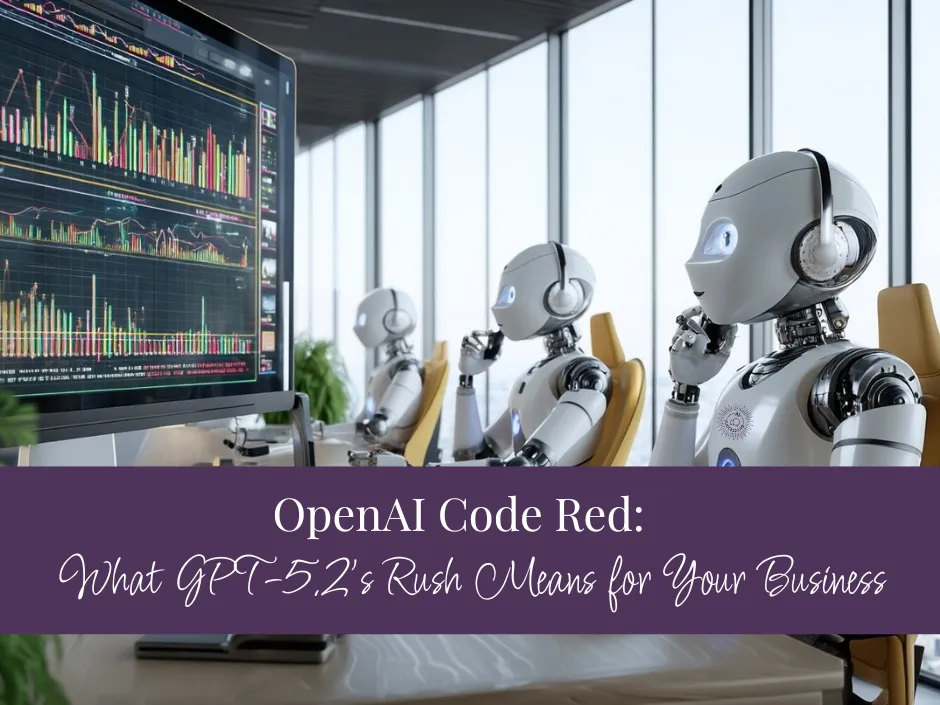
OpenAI Code Red: What GPT-5.2's Rush Means for Your Business
Why OpenAI's Scramble to Launch GPT-5.2 is Your Biggest Business Opportunity
The AI Arms Race is forcing providers to compete on speed and quality, and the real winner is you: the business owner.
The news is flying fast: OpenAI reportedly declared an internal "Code Red" after Google's Gemini 3 impressed key industry leaders, including OpenAI's own CEO. This urgent response means a rushed release of their next major update, GPT-5.2, set for this Tuesday, December 9th (though a launch date can always shift!). This is more than just tech drama; it’s a massive signal to every business owner that you need to shift your strategy right now.
Here is why this corporate scramble is the best thing that could happen to your productivity, and the three practical steps you must take to capitalise on it.

The Great AI Arms Race is Winning for You
The tech world moves in cycles, and we’re seeing a familiar pattern play out in hyper-speed. Three years ago, ChatGPT put Google on "Code Red". Now, Google has bounced back with Gemini 3, forcing OpenAI into its own state of emergency.
This back-and-forth race for the top spot is why you and I, the end-users, are the biggest winners.
What This Competition Gives You:
Better Core Performance: The focus is shifting from "flashy new features" to what actually makes a difference for business: Speed, Reliability, and Customisation. These models are being forced to become stable enough for real daily workflows, not just cool demos.
Faster Innovation Cycles: The pressure means new features and better models are coming out not yearly, but monthly. As a business owner, this means you get access to smarter, cheaper, and faster tools at a relentless pace.
Lower Costs and Better Value: As these giants compete to win market share, they are also forced to compete on price and quality. We can expect better token limits and more efficient models in the long run.
The bottom line is that the quality of the AI you rely on to draft emails, generate ideas, and automate tasks is only going up. That's fantastic news for your efficiency gains.
1: Wait for Day 3, Not Day 1
Whenever a tech giant rushes a product to launch, there is always a risk that things break. It’s called “execution risk,” and it’s a very real challenge when you’re dealing with a system as complex as a new reasoning model.
The reports suggest this new GPT-5.2 is an accelerated response, with teams postponing other projects to focus 100% on core model performance. Rushing an upgrade that was originally scheduled for later in December carries risk.
Your Practical Playbook for a Rushed Launch:
Do not switch your critical business processes to the new model on Day 1. Your lead-generating, proposal-writing, or client-facing workflows need to stay stable.
Let the tech enthusiasts find the bugs. There’s a whole community that loves to test and break new releases. Let them do the heavy lifting while you stay operational.
Test safely first. When the update is live, use a dedicated, non-critical task to test the new model’s performance. Check its speed, reasoning, and reliability against the model you are currently using.
Your goal is to adopt AI strategically, not chaotically. You are looking for a reliable partner, not a flashy toy.
2: Focus on the Task, Not the Tool
This entire “Code Red” situation proves one thing: AI is not a “set and forget” tool yet. We are in a period of high volatility, with the leaderboards changing every few months.
If your entire business relies on one tool's unique features, you’re creating a dangerous dependency. If that model degrades, changes its pricing, or gets beaten by a competitor, your workflow comes to a screeching halt.
The strategic shift you need to make right now is moving your focus from the Tool (ChatGPT, Gemini, Claude) to your AI Operating System.
Build a Tool-Agnostic AI Operating System:
Your system is the repeatable framework that guarantees high-quality output, no matter what model is under the hood. It’s what we call The Three Cs of High-Impact Prompting:
Context: The who, what, and why. Tell the AI who it is and what background information it needs.
Clarity: The specific job to be done. Give it a clear, single job.
Constraints: The guardrails. Specify the tone, length, format, and ethical rules.
If you have a well-structured prompt, you can use any model GPT, Gemini, or whatever comes next and get consistent, high-impact results. This gives you strategic redundancy and helps you avoid getting caught off-guard by model downtime or sudden API changes.
3: Scale Your Learning to Match the Pace
The AI arms race is accelerating innovation so fast that the skills you learned six months ago might already be outdated. Being "AI-ready" is no longer a one-time project; it is continuous education.
Leaders who see the most bottom-line impact from AI are those who treat it as a strategic capability and invest in continuous staff training. They focus on aligning AI adoption with core business objectives, not just chasing shiny objects.
How to Stay Ahead of the AI Curve:
Prioritise Alignment: Before you adopt any new tool, ask: "How does this help me achieve my specific business objectives?". Don't use AI for the sake of it.
Seek Practical Guidance: You need step-by-step training on how to turn complex tools into clear, high-impact, repeatable systems. This is the difference between dabbling and scaling.
Find Your Community: Being in a fast-moving, competitive landscape can feel overwhelming. Having a community of peers and experts means you don't have to stumble through every update alone. You get shared learning and ongoing support tailored to your evolving needs.
To win in the modern business climate, you can't just react to these "Code Red" news flashes. You need a trusted partner who gives you the clarity and practical steps to stay ahead.
The Strategy That Will Survive the AI Chaos
This high-speed, volatile environment requires a different kind of expertise one that blends technical know-how with human-centred strategy.
You need to move beyond single-tool training and adopt a complete, ethical, and scalable system for your business.
That’s why I created the AI Success Lab Elite Membership. It combines continuous education, live coaching, and a private peer community into one cost-effective subscription.
We give you the frameworks, the practical playbooks, and the sustained support to navigate the chaos, turn every update into an advantage, and build systems that free you from overwhelm.
Stop dabbling and start building a high-impact AI strategy that aligns with your long-term success.
Join us in the AI Success Lab Elite Membership here: https://aisuccesslab.com/aielitemembership
FAQ: What the AI Arms Race Means for My Business
What is the "Code Red" at OpenAI?
OpenAI’s "Code Red" is an internal state of the highest urgency, reportedly declared by CEO Sam Altman in response to Google's Gemini 3 outperforming their current models in key benchmarks. This status has led them to postpone other projects and rush the release of their next major update, GPT-5.2, to compete on core performance like speed and reliability.
How does the AI Arms Race benefit me as a business owner?
The intense competition between tech giants forces them to accelerate innovation, improve core product quality (speed, reliability, customisation), and ultimately compete on price. This means you get access to smarter, more capable, and more stable AI tools much faster than before.
Should I build my workflows on a single AI model like ChatGPT?
No. Relying on a single provider creates a dangerous dependency, leaving you vulnerable to changes in pricing, sudden downtime, or performance shifts. The strategic move is to build a tool-agnostic AI Operating System based on strong prompting frameworks (like Context, Task, Constraints) that allows you to switch between models effortlessly.