
The AI Agent Economy: Are You Still Hiring for Tasks AI Can Do?
In this article: The AI agent economy refers to the rapid rise of AI systems that can independently execute tasks and complete workflows within a business. Unlike traditional AI tools that respond to prompts, AI agents can manage multi-step processes, integrate with business systems, and operate with minimal human input. As adoption accelerates, small businesses are rethinking how work is structured, shifting repetitive, rules-based tasks to AI while focusing human effort on strategy, relationships, and decision-making. This article explains what the AI agent economy is, how it impacts hiring and operations, and how to start implementing AI agents in your business.
For the past few years, most conversations around AI in business have focused on efficiency. How can AI help us write faster, respond quicker, or reduce the time spent on repetitive work?
That conversation is now evolving into something more structural.
The question is no longer whether AI can assist with tasks. It is whether those tasks should exist as human responsibilities at all.
The emergence of the AI agent economy is forcing a shift in how businesses think about work itself. Instead of using AI as a tool that supports individual actions, businesses are beginning to implement AI systems that can complete entire workflows independently. This is not a distant trend or a theoretical concept. It is already embedded in many of the platforms businesses use every day.
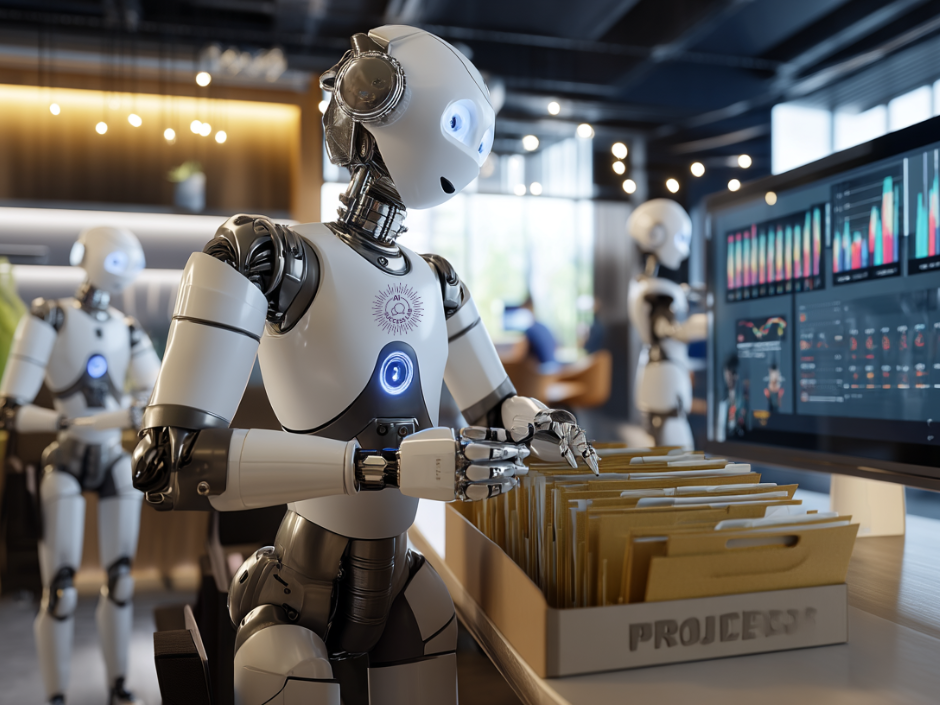
As a result, the real question is not whether AI will change how work gets done. It already has. The more relevant question is whether your business is still structured around tasks that no longer require a person to complete them.
What Is the AI Agent Economy?
The AI agent economy refers to the growing adoption of AI systems that can independently execute tasks, manage workflows, and operate across multiple tools without continuous human input. Unlike traditional AI, which responds to prompts or generates content in isolation, AI agents are designed to carry out a sequence of actions from start to finish based on a defined objective.
This shift is not incremental. It represents a fundamental change in how AI is used within business operations.
The data reflects the speed of this transition. The AI agent market grew from $8.29 billion in 2025 to $12.06 billion in 2026, representing a 45.5% increase in a single year . At the same time, Gartner projects that 40% of enterprise applications will include task-specific AI agents by the end of 2026, compared to less than 5% just a year earlier .
This kind of growth is not just a technology trend, it signals a broader economic shift. We explored this in more depth in a recent episode of The AI Grapple, where the conversation looked at whether AI is genuinely reshaping the economy or simply accelerating existing patterns of work.
How AI Agents Are Different From Traditional AI Tools
Most businesses are familiar with AI as a responsive tool. You provide an instruction, the system generates an output, and you decide what to do next. This model remains useful, particularly for drafting, brainstorming, and analysis.
AI agents operate differently.
Rather than waiting for instructions at each step, they are designed to execute a full workflow once a goal has been defined. This can include navigating software, retrieving and updating data, completing multi-step tasks, and delivering a final output without requiring constant input from a user.
Recent developments have accelerated this capability significantly. Modern AI systems can now manage complex workflows that involve multiple tools and decision points, often performing at a level comparable to human baseline performance in structured environments .
What this means in practice is that AI is no longer confined to generating responses. It is increasingly capable of completing work.
From Tool to Team Member
One of the most useful ways to understand this shift is to stop thinking about AI as a tool and start thinking about it as a team member.
This framing is becoming more widely accepted as businesses move beyond experimentation. When AI is viewed as part of the team, the focus shifts from features to responsibility. You begin to define what the agent owns, what decisions it can make, and what information it needs to perform effectively.
We explored this idea in a recent AI Grapple episode featuring David Espindola, where the conversation focused on whether businesses are acting as makers, shapers, or takers in the AI space. A key takeaway was that AI becomes significantly more valuable when it is trained on context, values, and decision-making frameworks not just prompts.
This perspective aligns closely with how AI agents should be implemented. Without context, they behave like tools. With context, they behave like team members.
What This Means for Small Businesses
For small business owners, this shift is particularly important.
In larger organisations, tasks are distributed across multiple roles and departments. There are systems in place to manage workflows, and responsibilities are shared. In small businesses, those same tasks often fall on a single person or a very small team.
Administrative responsibilities such as scheduling, data entry, reconciliation, reporting, and inbox management may not seem significant on their own, but collectively they represent a substantial investment of time. More importantly, they are repetitive. They follow patterns. They can be defined and structured.
This is exactly the type of work that AI agents are designed to handle.
Rethinking how these tasks are managed can have an immediate impact. It does not necessarily mean reducing headcount. Instead, it allows businesses to reallocate human effort toward work that genuinely requires human input, such as building relationships, making complex decisions, and delivering personalised experiences.
Building the Foundation for AI Execution
One of the most important aspects of implementing AI agents successfully is providing the right context.
Just like a new team member, an AI agent cannot perform effectively without understanding how your business operates. It needs access to the information, processes, and guidelines that shape your decisions.
This includes elements such as brand voice, standard operating procedures, client data, and internal workflows. When these are clearly defined and accessible, AI agents are able to produce outputs that are consistent, relevant, and aligned with your business.
Without this foundation, results tend to be generic and inconsistent. With it, AI becomes a genuine extension of your operations.
This is often referred to as an AI Operating System, the underlying structure that enables AI to function effectively within your business environment.
The Role of Governance and Boundaries
As AI agents become more capable, governance becomes increasingly important.
When an AI system has the ability to send communications, update records, or initiate actions, it must operate within clearly defined boundaries. This is not about restricting capability, but about ensuring control.
Effective governance can be simple. It may include setting permissions, defining what actions require approval, establishing review checkpoints, and maintaining a record of changes. Even in small businesses, having a clear framework for how AI is used helps reduce risk and maintain consistency.
The goal is not to limit what AI can do, but to ensure that its actions align with the standards and expectations of your business.
Taking a Measured Approach to Adoption
One of the common misconceptions about AI agents is that they require a complete overhaul of existing processes. In reality, the most effective approach is incremental.
Businesses that succeed with AI agents tend to start small. They identify a single workflow that is repetitive, time-consuming, and low-risk, and they focus on automating that process first. This allows them to test, refine, and build confidence before expanding further.
This measured approach also provides an opportunity to develop the systems and structures needed to support AI more broadly. Over time, these individual workflows can be connected to form a more comprehensive operational system.
Where to Start
If you are considering how to begin, the simplest starting point is to identify one task that is repeated consistently within your business.
Look for something that follows a clear set of rules and does not require complex judgement. Map out the steps involved, define the desired outcome, and consider what information would be needed to complete it automatically.
From there, you can begin to build a workflow that an AI agent can execute. This process does not need to be perfect. It needs to be clear.
Once the first workflow is established, it becomes easier to identify additional opportunities and expand your approach.
The Bigger Shift
The AI agent economy is not something that is approaching in the future. It is already influencing how work is structured across industries.
The businesses that benefit most will not be those that adopt the fastest, but those that adopt with intention. They will take the time to understand their workflows, build the necessary foundations, and implement AI in a way that supports long-term growth.
This is not just a technological shift. It is an operational one.
And for many businesses, it begins with a simple question:
Are you still organising your business around tasks that no longer need a person to perform them?
Ready to Start Building With AI Agents?
Understanding the shift to AI agents is one thing.
Knowing how to apply it inside your business is where the real value is created.
If you’re still manually handling repetitive workflows, there’s an opportunity to redesign how work gets done, not by adding more tools, but by building systems that execute for you.
👉 Join the workshop: AI Agents: How to Build and Use Them in Your Business
Inside, you’ll learn how to identify the right tasks to automate, build practical AI workflows, and turn AI from a tool you use into a system that supports your business.
Because the advantage isn’t in knowing what AI can do.
It’s in knowing how to implement it properly.
Frequently Asked Questions About the AI Agent Economy
What is the AI agent economy?
The AI agent economy refers to the growing use of AI systems that can independently execute tasks and workflows within businesses, reducing reliance on manual processes.
Are AI agents replacing jobs?
AI agents are primarily replacing repetitive tasks rather than entire roles. This allows people to focus on higher-value work that requires human judgment and interaction.
What tasks are best suited for AI agents?
Tasks that are repetitive, structured, and rule-based, such as data entry, reporting, scheduling, and workflow automation, are the best candidates.
Do small businesses benefit from AI agents?
Yes. Small businesses often benefit the most because they have limited time and resources, making efficiency gains more impactful.
How do I start using AI agents in my business?
Start with one simple workflow, define the steps and required inputs, and build a system that allows AI to execute it consistently. Then refine and expand.