

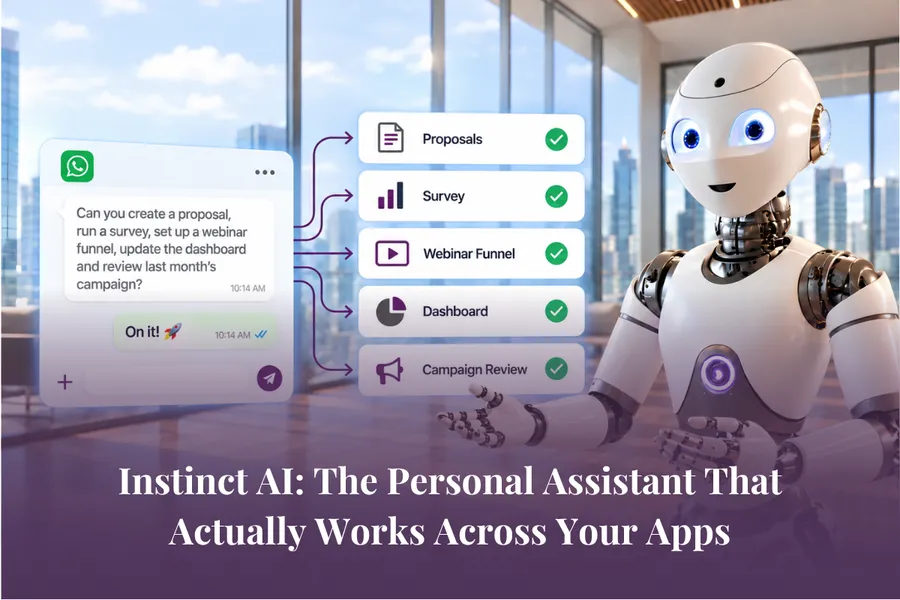
Instinct AI: A Personal Assistant That Takes Action
Short Answer: Instinct AI is a personal AI assistant designed to do more than answer questions. Instinct describes its assistant as being able to connect with applications and devices including email, messaging, screen, audio and location, while users communicate with it through text or calls.
That difference became very real for me during a week when I needed AI to do more than help me write. My daughter had her tonsils removed, so much of my week was spent in hospital or sitting beside her while she recovered. From whichever chair or bed I happened to be sitting in, I messaged Instinct through WhatsApp and gave it work to do.
It drafted proposals, built a HighLevel survey, prepared a website brief, analysed a webinar and Meta Ads campaign, developed a webinar funnel and helped build a connected dashboard. Some of those tasks still needed my judgement and review, but I wasn't sitting at my desk manually moving between every system.
That is what makes Instinct interesting. It points towards a different relationship with AI - one where the assistant understands more of the work around you, can move between tools, brings things to your attention and can take action rather than waiting for you to manage every individual step.
What Is Instinct AI?
Most of us have become used to a particular way of working with AI. Open ChatGPT, Claude or Gemini, type a prompt, get an answer, copy the answer somewhere else, return to the AI and give it another instruction.
Even when the AI is excellent, you are still managing the workflow.
Instinct is designed around a different model. The company describes it as a personal assistant that understands what you're working on and what is important to you. It says the assistant connects to your applications and devices, can be contacted by text or call, and is trained to use a phone and computer.
Instinct also describes proactive behaviours including following up on threads you've dropped and contacting you about things that need attention. This is less about asking AI for an answer and more about asking AI to get something done.
That distinction matters because it shifts your role. Instead of managing every prompt and every handover between platforms, you're increasingly defining the outcome, supervising the work and deciding where human judgement is required.
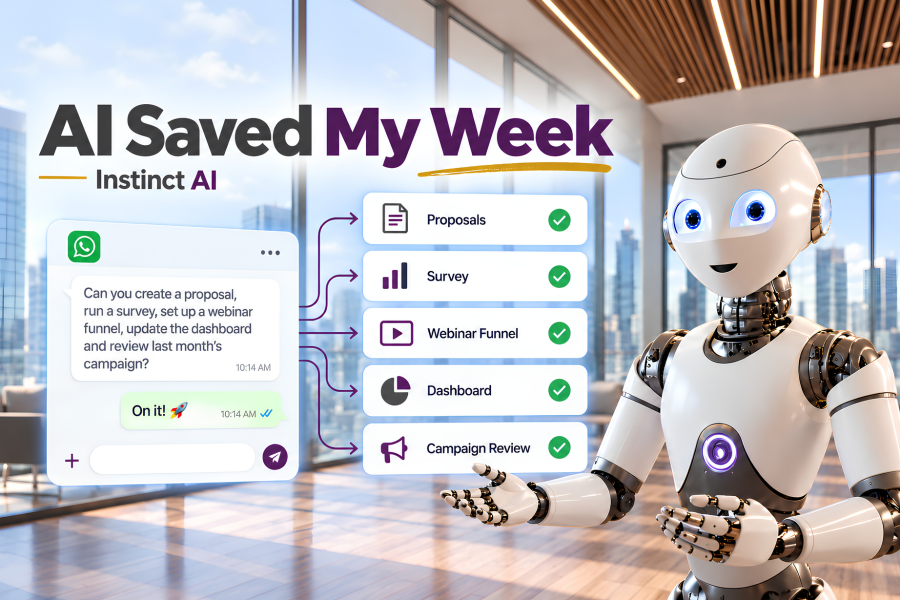
The Week Instinct Became More Than an Experiment
I discovered Instinct during a week when I had very little capacity to sit at my desk. My daughter's recovery from having her tonsils removed was rough, and normally a week like that would mean accepting that certain projects simply weren't going to move.
Instead, I started messaging my Instinct assistant, which had named itself Kit. One task turned into another, and I started testing just how far I could delegate.
What happened changed my view of what a personal AI assistant could actually look like in day-to-day business.
1. It Drafted Four Proposals From My Existing Information
I asked Kit to prepare four proposals and their associated emails. Rather than asking me to manually gather all the background first, it found the relevant transcripts in my Google Calendar invites and used that information to complete the work.
The task started with a one-sentence prompt through WhatsApp. Did I instantly send everything it produced? No.
The process still took me around an hour because I have very high standards for proposals and wanted to review and refine each one.
But there is an enormous difference between spending that hour creating everything from scratch and spending it reviewing work that has already been assembled for you. The goal is not removing humans from important work, it is changing where human time goes.
2. It Built a 17-Question Survey in HighLevel
This was where things became much more interesting. Kit didn't just write 17 survey questions and hand them back to me as text.
I logged into HighLevel and it built the survey there for me.
That is the shift businesses need to understand. Generative AI has become very good at telling us what to do, but agentic systems are increasingly capable of moving into the places where work happens and carrying out parts of that work.
Instead of AI writes the survey → I copy it → I open HighLevel → I build it, the workflow becomes I explain the outcome → AI executes more of the task → I review it.
That removes some of the repetitive movement between thinking about work and actually doing it.
3. A Website Brief Started Turning Into Actual Website Work
I also asked Kit to write a full brief for our website designer for a new waitlist page supporting the AI Success Lab Coaches. The work expanded into developing a platform to support availability and statistics tracking for the coaches, and I began testing Kit's website design skills directly inside our HighLevel site too.
This is where working with more capable assistants becomes interesting and where human oversight becomes more important. A task can begin as "Help me prepare the brief" and become "Can you actually build part of this?"
That is a very different level of delegation. Businesses need to recognise when they're crossing from AI helping with content or ideas into AI taking action inside operational systems.
4. It Analysed Our Webinar and Meta Ads Campaign
One of my strongest experiences with Instinct was asking it to analyse our most recent free webinar and Meta Ads campaign. It reviewed the available information and gave me direct recommendations about what we should do more of, what we should do less of and where the next campaign could improve.
For me, it was the sharpest campaign analysis I've seen from AI to date.
That is my experience with this particular campaign, not a claim that Instinct will outperform every other tool for every business. What it demonstrated was the value of context.
AI advice becomes much more useful when the assistant can work with the information surrounding a project rather than receiving isolated screenshots, documents and prompts one at a time.
5. A Staff Brief Became a Working Funnel
I then gave Kit a brief for our next free webinar. Initially, I expected help preparing material for the team, but the task expanded into webinar positioning, a title, a staff briefing document and a draft automation built inside HighLevel.
There used to be a very clear boundary between thinking about the work and doing the work. You asked AI to help plan a funnel, then a human built it. You asked AI to draft an automation, then someone logged into the platform and created it.
That boundary is becoming thinner. AI can increasingly participate in execution as well as planning.
6. It Helped Build a Connected Dashboard
One of the more complex tests involved building a dashboard in ChatGPT Sites with associated spreadsheets in Google Sheets. Kit helped build, connect and design the pieces needed for the system.
Again, the interesting part wasn't simply that a dashboard could be built. It was the way the task was initiated and managed.
I wasn't sitting at a desktop opening every platform and manually controlling every transition. Much of the interaction began through simple messaging in WhatsApp.
That starts to change what "working with AI" actually means.
Why Instinct Feels Different From the AI Most Businesses Use
The biggest difference for me has not been that Instinct can write. Plenty of AI tools can write, and I've already built sophisticated agents in my own business that can complete multi-step work.
What has felt different is the combination of context, action and proactivity.
Kit isn't only waiting for me to give it perfectly structured prompts. In my testing, it has been helping manage my to-do list, bringing things to my attention and suggesting ways to streamline and improve the work along the way.
The other difference is execution. Once I'm logged into the platform or app involved, Kit can work inside it rather than simply giving me instructions to follow. That's what made building the survey, funnel and other systems feel so different from my usual experience of AI.
For a small business owner wearing multiple hats, that could be far more meaningful than simply having another chatbot that writes faster.
But More Access Means More Responsibility
There is another side to this. An AI assistant becomes more useful when it has access to more of the context around your work, but that same access means you need to be much more deliberate about permissions and oversight.
If an assistant can interact with your email, calendar, screen, CRM, files or other business systems, you need to understand what information it can see and what actions it can take.
Before giving any AI assistant broad access, ask:
What data can the assistant access?
What permissions have I granted?
Can those permissions be limited?
Which actions can it perform without confirmation?
What client or employee information could become visible?
Where is information processed and stored?
What needs human approval before it is sent, published or changed?
What happens if the assistant makes the wrong decision?
The more capable the agent, the more important those questions become.
At the AI Success Lab, our principle remains simple: AI drafts, humans review, humans publish. For higher-risk actions, that human checkpoint may need to happen before the AI acts at all.
Don't Start With "How Much Can I Give It?"
Tools like Instinct can make it tempting to immediately connect everything. I wouldn't start there.
Start with the task. Choose work that is time-consuming, clearly defined and relatively low risk. Give the assistant enough access to complete that task, then assess what actually happens.
Did it understand the objective? Did it use the right information? Did it make sensible decisions? How much correction was required? Did it genuinely save time once your review was included?
This is also why we recommend assessing the task before choosing the technology. Our T.A.S.K framework for deciding whether your business is ready for AI agents helps identify where an agent is likely to create value and where you'd simply be adding complexity. The T.A.S.K framework stands for Time Test, Assemble, Score and Key in the right tools, giving businesses a practical way to assess a task before automating it.
Trust with more autonomous AI should develop through evidence, not enthusiasm.
What Instinct Tells Us About Where AI Is Heading
The bigger story here isn't one product. Instinct is interesting because it demonstrates the direction personal AI assistants are moving.
We are shifting from "Give me an answer" to "Help me complete this task", and increasingly towards "You understand what I'm working on - help me manage what needs to happen next."
We explored this same shift in The AI Grapple - Ep 50: Mari Smith on Trust, AI, and Staying Human in the Future of Social Media. Kate and Mari discuss the difference between generative and agentic AI, how agents may increasingly manage workflows and customer interactions, and the security and trust questions that come with giving AI deeper access to our systems.
That matters for small business owners because most don't need another interface to check throughout the day. They already have too many. What they need is help connecting work scattered across email, calendars, documents, CRMs, websites, spreadsheets and messaging platforms.
Instinct's approach is particularly interesting because the interface is built around communication people already understand - text and calls - rather than requiring another dashboard to manage.
The Real Test Is Whether It Reduces Your Work
There will be many personal AI assistants. Some will be impressive demonstrations and little more. Others may become part of how we work every day.
The test I care about is much simpler: Did this remove meaningful work from my plate while keeping me in control of the decisions that matter?
During an unusually difficult week, Instinct did that for me. It didn't remove my responsibility, lower my standards or mean I stopped checking important work. It meant I could delegate parts of my workload through a message while being where I needed to be personally.
That is the version of AI I'm interested in - technology taking on more of the administrative movement around work while humans keep responsibility for judgement, relationships and the things that deserve our attention.
Want to Move From AI Answers to AI That Actually Helps With the Work?
You don't need to connect AI to your entire business tomorrow. Start by identifying one task that repeatedly takes your time, understand the information and systems involved, and decide what you would comfortably delegate while keeping the right human checkpoints in place.
Our free AI workshop will show you how to identify where AI can make a practical difference in your business, build stronger systems around it and move beyond using AI one prompt at a time.
Frequently Asked Questions
What is Instinct AI?
Instinct is a personal AI assistant designed to understand what you're working on and interact with applications and devices including email, messaging, screen, audio and location. The company says users can communicate with it by text or call and that it is trained to use a phone and computer.
How is Instinct AI different from ChatGPT?
The difference is less about one being "AI" and the other being something completely different because ChatGPT also has agentic capabilities.
The distinction is how Instinct is designed to work across your wider digital environment and proactively help move work forward. Traditional chat-based use often gives you an output that you then move into another tool, while an agentic assistant can increasingly participate in the execution itself.
Can Instinct AI perform tasks inside other apps?
Working across applications and devices is central to Instinct's positioning. Its official website says it connects to applications and devices and is trained to use phones and computers. Instinct
In my own testing, I used Instinct for work involving Google Calendar information, HighLevel, campaign analysis, Google Sheets and other business tasks. Exact capabilities may depend on the systems, permissions and version available to you.
Is Instinct AI safe for business information?
No AI assistant should automatically be considered appropriate for every type of business information. The more access an assistant receives, the more important it becomes to understand permissions, privacy, data handling and the obligations that apply to your organisation.
Start with lower-risk tasks, limit access where possible and retain human approval for sensitive or consequential decisions.
Do I still need to review Instinct AI's work?
Yes. More autonomy does not remove the need for human judgement.
Proposals, emails, campaign analysis, websites, automations and other business outputs should still be checked against your requirements before they are relied on, sent or published. AI drafts, humans review, humans publish.
Is Instinct AI free and available to everyone?
When I shared my original experience, my access was free and invite-based, and I received no benefit from sharing an invite. Instinct is still developing, so access arrangements and features may change over time.
Check the current access conditions presented by Instinct before assuming the same availability or setup will apply to you.