
The AI Doc on Netflix: What Businesses Should Ask
Short Answer: The AI Doc: Or How I Became an Apocaloptimist is a useful introduction to the enormous questions surrounding artificial intelligence. Built around filmmaker Daniel Roher preparing to become a father, it asks what kind of future AI could create and gives prominent AI leaders and critics space to make their case.
Where the film is particularly useful is in making a difficult subject easier to engage with. It brings optimism and concern into the same conversation rather than pretending there is one simple answer.
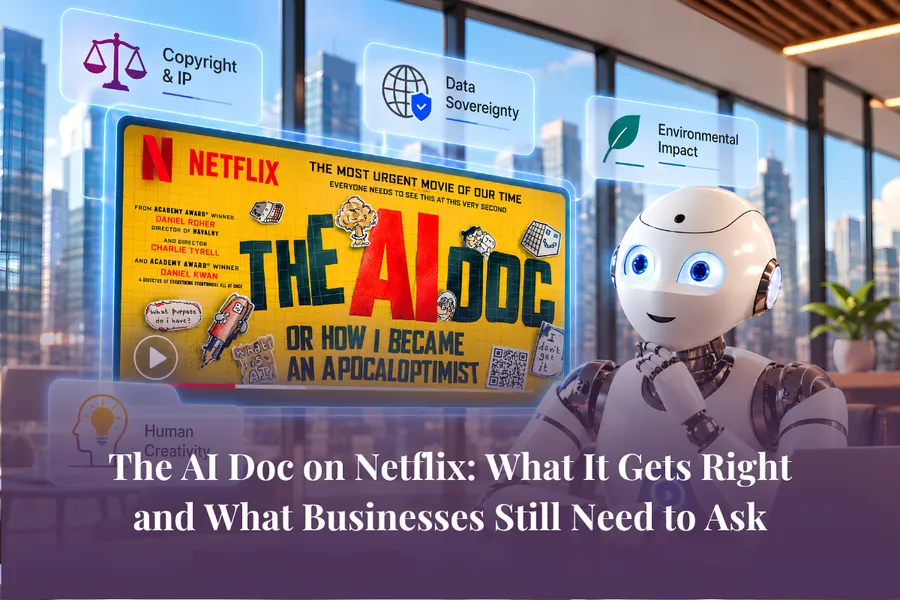
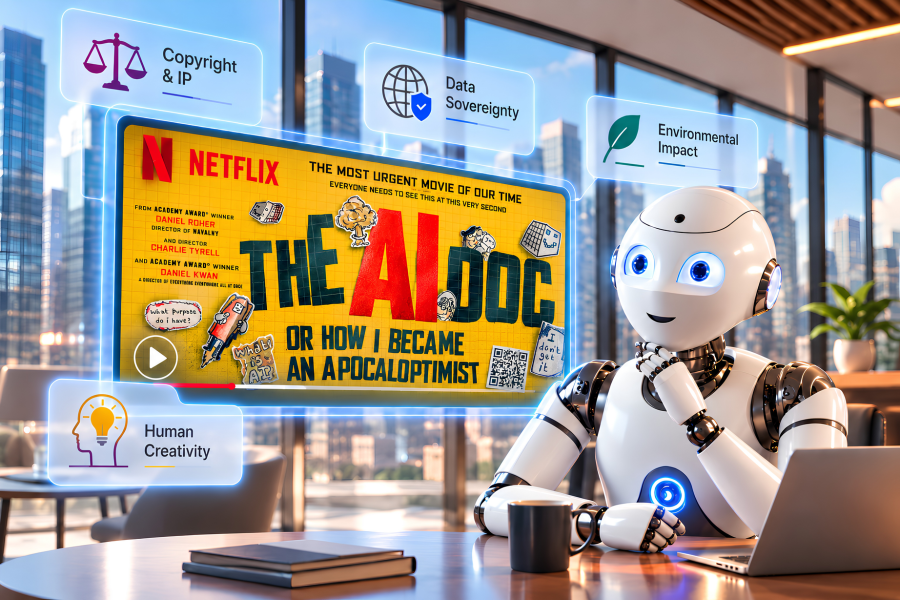
For business leaders, though, some of the most immediate questions sit underneath that bigger debate. Copyright, intellectual property, data sovereignty, environmental cost, employee concerns and human creativity all have consequences for the decisions organisations are making about AI today.
The practical response is not to choose between excitement and fear. It is to build enough AI literacy to ask better questions, put sensible guardrails in place and make deliberate decisions about where AI belongs in your organisation.
Why The AI Doc Is Worth Watching
AI conversations have a habit of drifting towards extremes. At one end, AI is presented as the answer to almost everything - productivity, medicine, education, climate challenges and scientific breakthroughs. At the other, we hear predictions about mass unemployment, misinformation, lost control and catastrophic risks.
The AI Doc: Or How I Became an Apocaloptimist puts those tensions in the same room. The documentary follows Daniel Roher, an expectant father trying to understand what AI could mean for the world his child will inherit.
That personal starting point gives a highly technical subject a human entry point. The film includes conversations with technology executives and experts while exploring the potential benefits and dangers of increasingly capable AI.
That accessibility matters because many people are not reading AI research papers or sitting through policy briefings. They are business owners, employees, parents and leaders trying to work out what this technology means for them. A documentary like this can open that door.
What The AI Doc Gets Right
One of the film's strengths is that it does not pretend there is a neat answer waiting at the end. That is much closer to the reality organisations are facing because AI can produce genuinely useful outcomes while creating difficult questions at exactly the same time.
A team may save hours using an AI assistant while also needing to decide what information that assistant should be allowed to access. A marketing team may create more content while wrestling with copyright, originality and disclosure. A leader may see significant productivity potential while employees are quietly worried about what AI means for their roles.
Those positions can coexist. The documentary also demonstrates another important truth: the conversation is moving quickly. A film can spend months being researched, filmed and edited while the technology it covers continues to change underneath it.
That is exactly why businesses need principles and policies that can survive the next product update rather than rules built around one particular AI tool.
Watch the Storytelling Critically Too
A documentary is still a constructed story. Someone decides who gets interviewed, which answers stay in the final cut, which questions receive the most attention and which themes drive the story forward.
That does not make the documentary unreliable. It means viewers should bring the same critical thinking to an AI documentary that they should bring to AI itself.
The film gives significant space to both AI industry leaders and organisations concerned about the risks of increasingly powerful systems. Those voices matter, but each participant also comes to the conversation with their own priorities, experiences and interests.
This is especially important when listening to claims about what AI may be capable of years from now. Companies developing advanced AI systems have commercial interests, advocacy organisations have missions and priorities, researchers may disagree about the likelihood or scale of particular risks, and governments have economic, security and regulatory considerations.
Rather than asking only, "Who is right?", a more useful question is: What evidence supports this claim, what assumptions sit behind it, and what decisions does this argument encourage us to make?
The Bigger AI Debate Can Hide Today's Business Questions
Discussions about artificial general intelligence, catastrophic risk and extraordinary future capability deserve attention. But organisations also have decisions sitting on their desks right now.
Which AI tools can staff use? Can client information be entered into them? Where is that information stored? Who owns the material used to train the systems? When does an AI-generated output require human verification?
Businesses also need to ask how employees should disclose AI use, what happens when someone has ethical concerns about a tool, and who is responsible for making those decisions. These questions may be less dramatic than predictions about humanity's future, but they determine how AI is actually adopted inside organisations.
And several of these issues deserve more attention than they receive in the film.
1. Copyright and Intellectual Property
Copyright remains one of the biggest unresolved concerns around generative AI. People want to know how models were trained, what rights creators retain, whether generated material can reproduce protected work and what happens when AI becomes part of commercial content creation.
For leaders, this is not simply a legal discussion happening somewhere outside the business. It can directly influence adoption.
Some employees are deeply uncomfortable using generative AI because they have concerns about how training data was obtained or how creative work is treated. They may not announce that concern in a meeting. They may simply choose not to use the technology.
That quiet resistance matters. A responsible AI plan needs room for those conversations. Telling people that a tool has been approved is different from helping them understand why it was approved, what the boundaries are and what concerns have been considered.
2. What Happens to Human Creativity?
The obvious question is whether AI will affect creative jobs. The deeper question is what happens to how people create.
Writing, designing, researching, composing and developing ideas are not simply methods of producing an output. The process itself helps people think, practise judgement, develop taste and form new ideas.
If AI takes over too much of that process, what happens to those capabilities? That does not mean organisations should avoid generative AI. It means we need to be thoughtful about which parts of creative work we delegate.
There is a meaningful difference between using AI to challenge an idea, organise research or produce a first draft and handing the entire thinking process to a machine. Human judgement still matters.
At the AI Success Lab, our principle is simple: AI drafts, humans review, humans publish.
3. AI's Environmental Cost Deserves More Than a Footnote
The environmental impact of AI is complicated. AI systems require data centres, computing infrastructure, electricity and cooling, while the environmental cost varies depending on energy sources, infrastructure, location and how the systems are being used.
It is difficult to reduce that to either "AI is environmentally disastrous" or "technology will solve the problem". For organisations serious about responsible AI adoption, the environmental conversation belongs alongside questions about productivity and cost.
Kate explored this issue further with sustainability expert John Pabon on The AI Grapple Podcast, looking at how businesses can think about AI, sustainability, transparency and responsibility without falling into exaggerated claims.
The useful question for a business is not whether AI is perfectly sustainable. It is whether you understand enough about the environmental consequences of your technology choices to make them deliberately.
4. Data Sovereignty Changes the Conversation in Australia
This is one of the areas where a predominantly American discussion about AI can leave Australian organisations wanting more. Data sovereignty asks where information is stored, processed and governed.
For an Australian not-for-profit, health provider, financial services business, government agency or organisation handling sensitive information, that can be one of the first questions to answer before adopting an AI platform.
It is not enough to know that an AI tool is popular or capable. Leaders need to understand what information employees are placing into it, what happens to that information, what contractual settings apply and whether the tool fits their organisation's privacy, security and governance obligations.
For a deeper Australian perspective, listen to The AI Grapple - Australia’s AI Strategy Explained by the Head of the National AI Centre, which explores data security, privacy, sovereignty, environmental impact and responsible AI adoption in an Australian context.
The answer may differ between a freelancer drafting a social caption and a health organisation working with sensitive client records. "Can this AI do the task?" is only one part of responsible tool selection. "Should we allow it to do this task with this data?" is often more important.
What Businesses Should Ask After Watching The AI Doc
The documentary gives you the big questions. Your organisation still needs to turn them into decisions.
Start with what is already happening inside your business rather than writing a lengthy AI policy nobody will use. Ask:
Which AI tools are our people already using?
What tasks are they using them for?
What business, employee or client information is being entered?
Which tools have we formally approved?
Where is our data processed and stored?
What do our contracts and privacy requirements allow?
What content requires human review?
How are we handling copyright and intellectual property?
What concerns do employees have about AI?
Who is responsible for reviewing our AI practices as the technology changes?
You do not need perfect answers before your organisation can move forward, but you do need visibility. An AI policy written without understanding what employees are actually doing will only solve part of the problem.
Talk to the people doing the work, identify the tasks where AI is already appearing and build guardrails around reality.
Move Beyond "AI: Good or Bad?"
Perhaps the most useful outcome of The AI Doc is that it gives people permission to sit with competing possibilities. AI can help, and AI can cause harm. The technology can make some work faster while creating new risks.
It can support creativity while raising serious questions about creative ownership. It can provide businesses with capabilities that previously required far more time or resources while also creating difficult questions about privacy, employment and responsibility.
We do not need to flatten those tensions into a simple position. For business leaders, the job is more practical: understand what your people are doing, understand the risks attached to those uses, decide where AI creates genuine value and put humans around the decisions that matter.
That is responsible AI adoption - not panic, not blind enthusiasm, but better judgement.
The Conversation Your Team Should Have
If you watch The AI Doc with your leadership team, do not finish with, "So, are we optimistic or pessimistic?" Ask something more useful: What did this film make us realise we haven't discussed yet?
Maybe it is copyright. Maybe your team has never agreed on what information can go into ChatGPT or Claude. Maybe employees are already using AI tools you did not know about.
Your organisation may have focused entirely on productivity without asking how people actually feel about the change. Or perhaps your AI policy is sitting in a folder while everyday work has already moved beyond it.
Those are conversations worth having. The future of AI may be difficult to predict, but what your organisation chooses to do with AI this week is much more within your control.
Ready to Turn AI Questions Into Practical Action?
AI conversations can become enormous very quickly. The best place to start is much smaller - with the tasks, people and decisions inside your own business.
Our free AI workshop will help you identify where AI can genuinely support your work, where human judgement still matters and how to start building practical AI capability without chasing every new tool.
Frequently Asked Questions
What is The AI Doc: Or How I Became an Apocaloptimist about?
The AI Doc: Or How I Became an Apocaloptimist is a 2026 documentary directed by Daniel Roher and Charlie Tyrell. It follows Roher, a father-to-be, as he speaks with AI executives and experts and investigates what artificial intelligence could mean for his child's future and society more broadly.
The film explores the promise and potential dangers of AI rather than arguing for one simple conclusion. It works as an accessible introduction to some of the largest questions surrounding the technology.
Is The AI Doc available on Netflix?
The documentary is available through Netflix in selected markets, although availability can vary by country. Viewers should check their local Netflix catalogue to confirm whether it is currently available in their region.
What does The AI Doc miss for business leaders?
The film tackles the large societal debate well, but several practical business issues deserve deeper attention. These include copyright and intellectual property, data sovereignty, human creativity, employee resistance, environmental impact and the everyday governance of AI tools.
These are often the issues leaders need to address before deciding how AI should be used across their organisation.
What should a business do before adopting more AI tools?
Start by understanding how AI is already being used. Identify the tools, tasks, information involved and any areas where employees are making their own decisions without guidance.
From there, set clear boundaries around approved tools, sensitive data, human review, copyright, disclosure and accountability. Review those decisions regularly because AI products and their terms can change quickly.
Do businesses need an AI policy?
If people in your organisation are using generative AI for work, clear guidance is increasingly important. A useful AI policy should explain approved use, restricted information, privacy and security expectations, human review requirements and who employees can ask when they are unsure.
The policy should support responsible use rather than simply banning AI or leaving every employee to decide for themselves.