
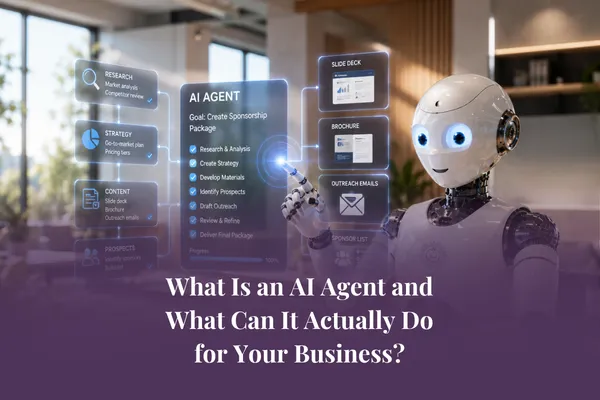
What Is an AI Agent and What Can It Do for Your Business?
Short Answer: An AI agent is an autonomous system that doesn't just respond to your questions - it takes action on your behalf. Unlike the AI tools most business owners are already using, an agent can perceive its environment, make decisions, and execute a sequence of tasks to reach a goal, all with minimal input from you. For small business owners, that distinction changes everything.
You've Heard the Term. But What Does It Actually Mean?
If you've been seeing "AI agents" everywhere lately and quietly wondering what it actually means for your business, you're in good company.
Most business owners have had some experience with AI by now. You've typed a question into ChatGPT or Gemini. You've asked it to write a caption, draft an email, or summarise a document. That's generative AI doing what it does best: responding to your input, one turn at a time.
An AI agent is a different thing entirely.
Think about it this way. With a large language model, you're having a conversation. You ask, it answers. You ask again, it answers again. It's a back-and-forth, and you're managing every step. With an AI agent, you hand over a goal - and it figures out how to get there.
Kate vanderVoort, founder of the AI Success Lab, describes it like this: "AI agents are autonomous systems that can perceive their environment, make decisions, take actions to achieve specific goals, all with minimal human intervention."
That word - autonomous - is the one that matters most here.
The Real Difference Between a Large Language Model and an AI Agent
Here's a simple way to tell them apart.
A large language model - ChatGPT, Claude, Gemini - is built for conversation. It generates text based on patterns in data. You prompt it, it responds. Every interaction is essentially a single turn. You're always in the driver's seat, managing the process step by step.
An AI agent combines all of that capability with something more: structured reasoning, memory, task management, and the ability to use tools. It's goal-focused rather than response-focused. You paint a clear picture of the endpoint you want, and the agent sets about achieving it.
The shift in your role is significant. With a large language model, you're a conversation participant. With an AI agent, you're a task delegator and supervisor. It might sound like a subtle distinction but it's a very big difference in practice.
What Can an AI Agent Actually Do?
This is where it gets real. Here's an example that illustrates the difference clearly.
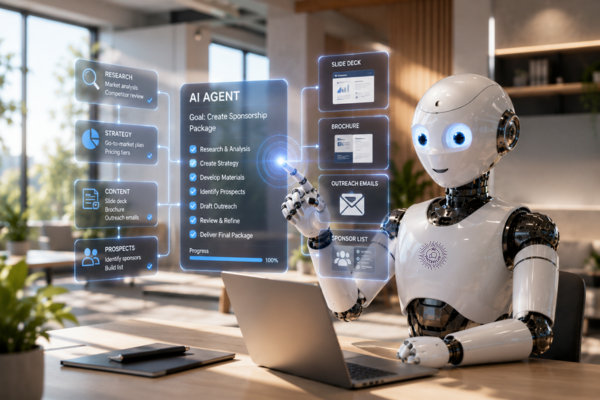
Say you're running an event management business and you need a complete sponsorship package - pricing tiers, a go-to-market strategy, outreach emails, a slide deck, a brochure, and a list of potential sponsors to pitch.
With a large language model, you'd need to break that down into fifty or more individual prompts, each one building on the last, with you directing every step. You'd spend hours managing the process.
With an AI agent, you give it the full brief, the context it needs about your business, a clear picture of what success looks like - and it just goes. It creates a to-do list of every phase, works through each one, checks its own errors, and delivers a complete package.
As Kate describes it from her own use: "Think about how much time this would take. This would be days or weeks of work." The agent compresses that into minutes.
That's not theoretical. That's what platforms like Manus are doing right now for small business owners who know how to use them.
Where Do AI Agents Live?
AI agents aren't a single product you sign up for. They're a capability that exists across several platforms, some you may already be using.
The most accessible options for small businesses right now include:
Manus - Designed specifically for autonomous, multi-step task execution. Give it a big, complex brief and it goes off and executes. Kate's current favourite for meaty tasks.
Genspark - More intuitive and collaborative in feel. A strong starting point if Manus feels like a stretch.
ChatGPT with Agent mode - Familiar interface, increasingly capable. Good for content and research tasks within the ChatGPT environment.
Claude Projects - Strong for tasks requiring a lot of context - long-form content, nuanced writing, anything where brand voice and accuracy matter.
Zapier AI - Best for connecting your existing tools through automated workflows triggered by real events in your business.
One thing worth knowing: these platforms aren't completely separate technologies from the large language models you already use. Most of them are built on top of those same models with an additional layer that makes them goal-oriented, autonomous, and capable of using tools rather than just generating text.
In fact, some of the most advanced agent platforms are running on nine different large language models at once underneath, with that layer on top that makes them smarter and more capable of taking independent action.
What You Actually Need Before You Deploy One
Here's the part that gets skipped most often and it's the reason so many early attempts with AI agents fall flat.
An agent is like an eager new team member. It wants to do a great job. But if you haven't told it who you are, who you serve, what your standards are, and what a good result actually looks like it'll fill in the gaps on its own. And that's where things go generic.
You don't go to the doctor and not share your symptoms hoping for an accurate diagnosis. The same principle applies here. The context and background you provide upfront is what determines the quality of everything the agent produces.
Before you hand anything to an agent, you need:
A clearly defined goal - not "help with marketing" but exactly what you want the end product to look like
Context about your business - your brand voice, your ideal clients, your products and services
Guardrails - what the agent must never do, and what always needs human review before it goes anywhere
That foundation - built before the agent is ever deployed - is what separates businesses that get genuinely impressive results from those that give up after a week and conclude that agents aren't ready for real business use.
They are. But they need something real to work with.
Is This Relevant to Your Business Right Now?
Yes, if you're a small business owner spending significant time on content, client communication, research, or repetitive administration.
You don't need to understand how agents work at a technical level. You don't need to be an AI expert. What you need is a clear answer to three questions: what problem do I want to solve, which tasks are costing me the most time, and what does a good result look like?
That's the strategic question. And it's a much better place to start than asking which tool to use.
In a recent episode of The AI Grapple, Kate and social media pioneer Mari Smith explored exactly this shift - from AI as a content assistant to AI as an autonomous operator. It's a conversation worth your time if you want to understand where this is heading and what it means for small businesses that want to stay ahead of it.
For now, the most important thing to understand is this: AI agents aren't replacing the thinking. They're replacing the doing, once you've done the thinking first.
If you want to explore what that looks like in practice, our free webinar walks through how to build an AI-powered business from the ground up including how to identify which tasks are most ready for this kind of automation.
👉 Join us for the free session here.
Frequently Asked Questions About AI Agents
What is an AI agent in simple terms?
An AI agent is an autonomous system that can perceive its environment, make decisions, and take action to achieve a goal - with minimal input from you. Unlike standard AI tools, you don't manage each step. You hand over the goal and the agent handles the execution.
How is an AI agent different from ChatGPT?
ChatGPT used as a standard large language model is a conversational tool - you prompt it, it responds, one turn at a time. An AI agent goes further: it can use tools, access information across platforms, make decisions across multiple steps, and complete complex tasks autonomously. Some versions of ChatGPT now include agent capabilities.
Do I need technical skills to use an AI agent?
No. Platforms like Manus, Genspark, and ChatGPT with agent mode are designed for non-technical users. What you do need is clarity about your goal, good context about your business, and clear guardrails - not coding skills.
What can an AI agent do for a small business?
Common use cases include creating complete project deliverables, content production workflows, client intake and follow-up, research and competitive analysis, and building marketing assets. The key is giving it a well-defined goal and enough context to work with.
Are AI agents safe to use?
With the right guardrails in place, yes. Always have a human review agent outputs before they go to clients or get published. Keep a human in the loop for any decision that carries reputational, financial, or legal risk. AI drafts. Humans review. Humans publish.
How do I get started with AI agents?
Start by identifying your highest-friction, most repetitive task. Define exactly what a good outcome looks like. Then choose a platform that fits your existing tools and working style. Our free webinar walks you through this process step by step.