
What Is Vibe Coding and Why Should Small Business Owners Care?
A year ago, if you wanted to build a custom tool for your business - a quiz, a calculator, an interactive lead magnet, a simple web app - you had two options. Hire a developer and pay thousands of dollars, or use a template platform and accept its limitations.
Most small business owners chose the template. Or they put the idea in the "one day" pile and moved on.
That calculation is changing fast. A new way of building digital tools has emerged, and it does not require a single line of code. It is called vibe coding - and it is one of the most significant shifts happening in the AI space right now for non-technical business owners.
So What Exactly Is Vibe Coding?
Vibe coding is the practice of describing what you want to build in plain English and letting AI do the technical work of actually building it.
Instead of writing code, you write prompts. You tell the AI what you need - a quiz that helps people find the right service for their situation, a calculator that shows a client their potential ROI, a simple dashboard that pulls together your key metrics - and the AI generates the underlying code and structure to make it work.
The term was coined by AI researcher Andrej Karpathy earlier in 2025, and it has since become shorthand for a broader shift - one where the barrier between "I have an idea" and "this thing exists" is collapsing for non-technical people.
You do not need to understand how the code works. You need to know what you want to build and be able to describe it clearly.
Why Is This Different From Website Builders?
You might be thinking - is this not just what Squarespace or Wix already does?
Not quite. Template-based website builders give you a fixed set of options within a pre-designed structure. You choose a layout, fill in your content, and customise within the limits of what the platform allows. That works well for standard websites - but it breaks down the moment you want something custom.
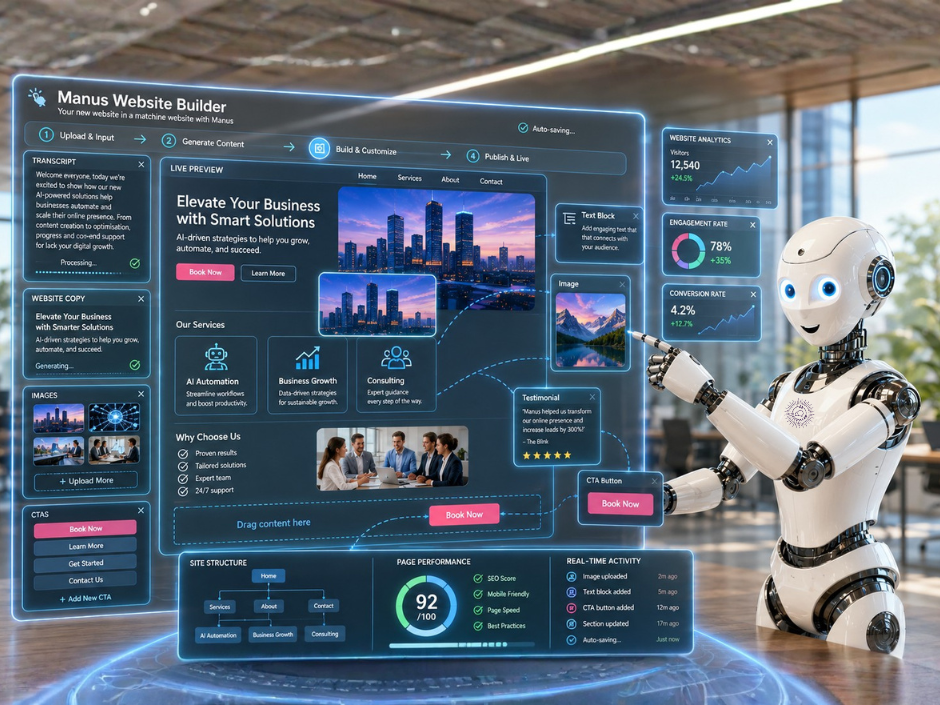
Vibe coding tools are different because they build from your description, not from a template. You are not choosing from existing components - you are describing something that does not exist yet and having it built for you in real time.
This means you can create things that would previously have required a developer:
A quiz that segments your audience by their biggest challenge and delivers a personalised result
A calculator that shows a prospect the time or money they could save by working with you
A simple app that guides a client through a process step by step
An interactive tool that collects information and delivers a customised recommendation
These are not theoretical examples. Business owners are building these things right now using tools like Lovable, Claude Artifacts, Gemini Canvas, and Manus - without any coding background.
What Tools Are People Using?
The vibe coding landscape is moving quickly, but a few tools have emerged as particularly accessible for non-technical users.
Lovable is a tool specifically designed for building web applications using natural language. You describe what you want, it builds a working prototype, and you can iterate through conversation. It handles the technical infrastructure so you do not have to.
Claude Artifacts - built into the Claude AI platform - lets you create interactive content, tools, and simple applications directly within a conversation. It is particularly useful for building things you want to embed or share quickly without needing a separate platform.
Gemini Canvas is Google's collaborative workspace within Gemini that allows you to build and refine documents, code, and interactive content in real time through conversation.
Manus is an AI agent platform that can handle more complex, multi-step builds - useful for business owners who want to automate processes or build more sophisticated tools.
Each tool has its strengths, and the right choice depends on what you are trying to build. What they share is the same fundamental shift - you describe, AI builds.
Why Should Small Business Owners Pay Attention?
The honest answer is that vibe coding gives small businesses access to something that was previously only available to businesses with development budgets.
Custom digital tools - quizzes, calculators, interactive lead magnets, personalised recommendation engines - are some of the highest-converting assets in marketing. They perform well because they are engaging, they deliver immediate value, and they create a personalised experience for the person using them.
Research consistently shows that interactive content generates significantly more engagement than static content. A PDF checklist might get downloaded. An interactive quiz gets completed, shared, and talked about.
Until recently, building these kinds of tools was out of reach for most small businesses. Vibe coding changes that. A well-described prompt and the right tool can produce a working prototype in an afternoon - something that would have taken a developer days or weeks to build.
This does not mean every business needs to start building apps tomorrow. But it does mean the creative constraints that used to exist around digital tools are lifting - and the business owners who start experimenting now will be ahead when this becomes mainstream.
What Does This Have to Do With Marketing?
Everything, when it is done well.
The most powerful application of vibe coding for small business marketing is in the creation of interactive content that serves your audience at different stages of their journey.
Someone who has just discovered your business might engage with a quiz that helps them identify their biggest challenge. Someone who is evaluating whether to work with you might use a calculator that shows them the potential value of your service. Someone already in your community might use a tool that helps them implement something they have just learned.
Each of these touchpoints does something a static blog post or social caption cannot - it creates an active, personalised experience. That kind of engagement builds trust faster and converts at a higher rate.
Over the coming weeks, we will be going deeper into how to use AI to build interactive content for your marketing - from the strategy behind choosing the right tool for your audience, to what is actually outperforming traditional lead magnets right now.
If you want to get a solid grounding in the broader AI-powered marketing system before we go further, the AI content calendar post from last month is a strong place to start - it covers how to think about content strategy before adding new formats and tools into the mix.
The Mindset Shift That Makes It Work
Vibe coding is not just a technical development. It is a mindset shift about who gets to build things.
For a long time, "I am not technical" was a legitimate reason not to pursue certain ideas. That excuse is becoming less valid by the month. The tools are catching up to the imagination of non-technical people - and the gap between having an idea and being able to execute it is narrowing significantly.
That does not mean there is no learning curve. Describing what you want clearly, iterating when the first result is not quite right, and understanding what each tool does well - these are skills worth developing. But they are skills built through experimentation, not through learning to code.
The best way to start is to pick one small thing you have wanted to build and try it. A simple quiz. A basic calculator. A one-page tool that solves a specific problem for your audience. See what the tools can produce. Refine from there.
Want to Learn How to Build With AI - No Developer Needed?
If you are curious about what AI can help you build and how to get started with confidence, our free workshop is the right place to begin. We cover the AI-powered business system from the ground up - practical, jargon-free, and designed for business owners who want results, not theory.
👉 Join the free workshop: Create an AI-Powered Business
Frequently Asked Questions About Vibe Coding for Small Business
What is vibe coding?
Vibe coding is the practice of building websites, apps, tools, and digital experiences by describing what you want in plain English and letting AI generate the technical build. It requires no coding knowledge - just the ability to clearly describe what you need and iterate from there.
Do I need any technical skills to try vibe coding?
No. The core skill is being able to describe what you want clearly and specifically. If you can write a detailed brief or a good AI prompt, you have the foundation you need. Tools like Lovable, Claude Artifacts, and Gemini Canvas are designed for non-technical users.
What can small businesses actually build with vibe coding?
Quizzes, calculators, interactive lead magnets, simple web apps, dashboards, recommendation tools, and step-by-step guided experiences - among other things. The main constraint is being able to describe clearly what you want to build and what it needs to do.
Is vibe coding the same as using a website builder like Squarespace?
No. Website builders work from templates with fixed options. Vibe coding tools build from your description, which means you can create custom tools and experiences that template platforms cannot produce.
Which vibe coding tools are best for beginners?
Claude Artifacts and Lovable are strong starting points for non-technical business owners. Both are designed to work through natural language conversation and produce working prototypes quickly. The best tool depends on what you are trying to build - which is worth exploring as your familiarity grows.